

Discover the key car finance trends shaping 2026 in Australia, from EV loan surges and interest rate shifts to smart strategies for securing the best deal.
Car finance trends Australians must know for 2026
TL;DR:
- Electric vehicle financing surged 161% in early 2026 due to rising demand and government incentives.
- Digital platforms are transforming Australian car finance with faster approvals and more options.
- Buyers should compare total costs, understand loan types, and prepare credit profiles to secure the best deals.
Electric vehicles now make up 14.6% of new car sales in Australia, and finance for them soared by 161% in early 2026. That's not a small shift. It's a signal that the entire car finance landscape is being rewritten, faster than most buyers realise. If you're planning to purchase a vehicle this year, the strategies that worked in 2023 or even 2024 may leave you paying more than you should. This guide walks you through the biggest trends reshaping car finance, what it costs, how lenders are changing their approach, and the practical steps you can take to secure a deal that actually works for your situation.
Table of Contents
- What's driving car finance growth in 2026?
- Electric vehicles and hybrid finance: The 2026 boom
- Loan types, leasing, and costs: What's new in 2026?
- Interest rates, credit profiles, and approval in a changing market
- How to choose and get the best deal in 2026
- Why most Aussie car buyers underestimate 2026's finance shake-up
- Compare car finance and secure a smarter deal with OptiCheck
- Frequently asked questions
Key Takeaways
| Point | Details |
|---|---|
| EV finance dominates | Electric vehicle and hybrid car loan demand is soaring in 2026, impacting loan terms and options. |
| Digital tools matter | Online applications and comparisons are streamlining the process and saving Australians time and money. |
| Careful comparison is key | Comparing loan types, fees, and rates is vital as interest rates and approval hurdles increase in 2026. |
| Policy shifts affect costs | Recent government policy changes, like those impacting fringe benefits tax, are reshaping finance value for buyers. |
What's driving car finance growth in 2026?
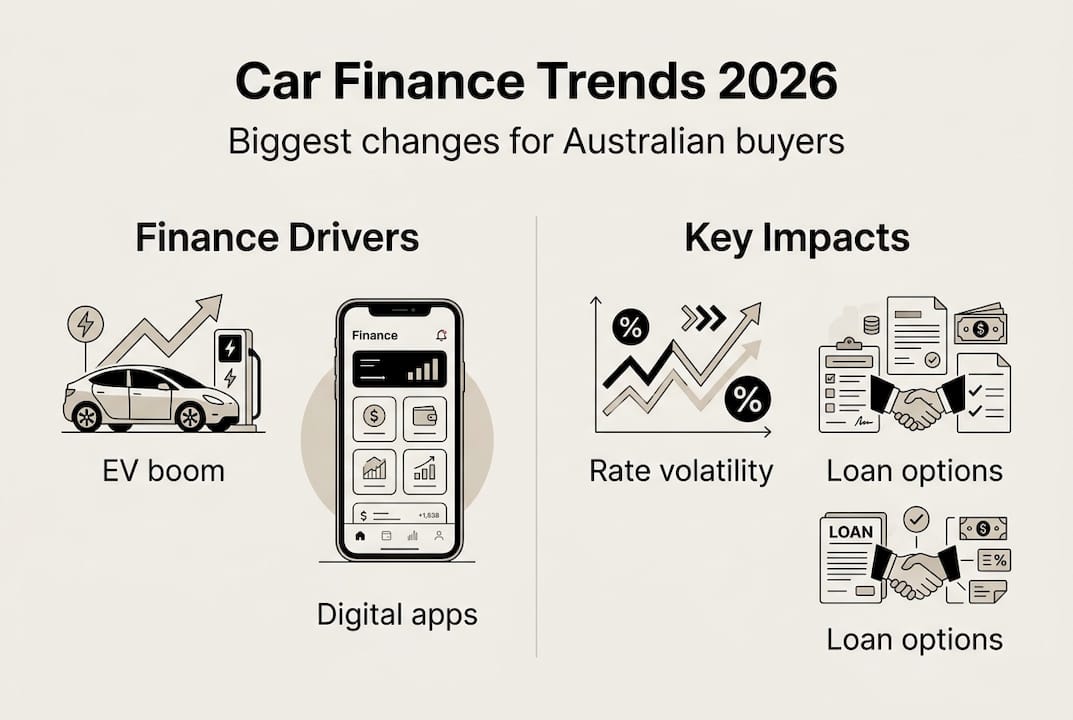
The car finance market in Australia is not standing still. A combination of rapid EV adoption, digital disruption, and shifting economic conditions is pushing the industry into new territory. For buyers, that means more options but also more complexity.
The numbers tell a clear story. Australia's vehicle financing market is growing at a 9.2% compound annual growth rate, with projections reaching $19.92 billion by 2033. That kind of growth is not happening by accident. It reflects a market responding to genuine demand.
Several forces are converging at once:
- EV adoption is accelerating, creating demand for new finance products tailored to higher purchase prices and longer loan terms.
- Digital platforms are transforming how Australians apply for and compare loans, reducing the friction that once made car finance feel overwhelming.
- Interest rate volatility is forcing buyers to think more carefully about fixed versus variable loan structures.
- Wage growth and cost-of-living pressures are reshaping what buyers can realistically afford.
Understanding digital disruption in car finance is no longer optional for savvy buyers. The lenders winning market share in 2026 are those offering fast online approvals, transparent fee structures, and flexible repayment terms. If you're still walking into a dealership and accepting whatever finance package they hand you, you're likely leaving money on the table.
For anyone new to borrowing, brushing up on the basics of car finance before you apply will help you ask better questions and spot a poor deal before you sign.
| Driver | Impact on market |
|---|---|
| EV adoption | Higher loan values, new product types |
| Digital platforms | Faster approvals, more lender competition |
| Interest rate changes | Shift toward fixed-rate products |
| Policy updates | Changes to fleet and novated lease demand |
Electric vehicles and hybrid finance: The 2026 boom
The EV finance surge is the single biggest story in Australian car lending right now. In 2025, lenders financed $7.37 billion for EVs and hybrids combined, up 20% year-over-year. Then in March 2026, EV loans jumped another 161%. Those are extraordinary figures.
What's fuelling this? Rising petrol prices have pushed more buyers toward EVs as a long-term cost play. Government incentives, including stamp duty exemptions in some states, have lowered the barrier to entry. And as more EV models enter the market at different price points, the audience for EV finance has widened considerably.
However, not all EV finance news is positive. Hybrid vehicle finance for corporate fleets dropped sharply after fringe benefits tax (FBT) policy changes removed the exemption that once made hybrids attractive for employers. This has had a real impact on fleet managers and employees using salary packaging.
Here's how EV and petrol car finance compare right now:
| Feature | EV finance | Petrol car finance |
|---|---|---|
| Average loan amount | Higher (often $60,000+) | Lower (often $30,000–$50,000) |
| Typical loan term | 5–7 years | 3–5 years |
| Government incentives | Available in some states | Minimal |
| Resale value risk | Higher uncertainty | More established |
| Lender availability | Growing but fewer specialists | Wide range |
Worth knowing: EV resale values are still less predictable than petrol vehicles. If you're financing a higher-value EV, factor in residual value risk before committing to a long loan term.
For rural buyers, EV finance carries additional risk. Charging infrastructure gaps and longer distances between services can affect insurance costs and resale value, which lenders are beginning to price into their risk assessments. Exploring car finance options for EVs before you apply will help you understand which lenders are genuinely competitive for your vehicle type.
Pro Tip: If you're buying an EV, ask your lender specifically about green loan products. Some lenders offer lower rates for EVs as part of sustainability initiatives, and these deals are not always advertised prominently.
Loan types, leasing, and costs: What's new in 2026?
Not all car finance is the same, and choosing the wrong structure can cost you thousands over the life of the loan. In 2026, the three main options are still car loans, standard leases, and novated leases, but the details have shifted.

Car loans remain the most popular choice because they offer ownership at the end of the term and flexibility to sell or modify the vehicle. You pay principal and interest, and once the loan is cleared, the car is yours outright.
Standard leases suit buyers who want lower monthly payments and don't need to own the vehicle. The trade-off is that you never build equity, and you may face charges for excess kilometres or wear at the end of the term.
Novated leases are employer-sponsored arrangements where repayments come from your pre-tax salary. They can deliver genuine tax savings, but as noted, residual risk and employer dependency are real considerations. If you change jobs, the arrangement can become complicated quickly.
Key costs to watch for in 2026:
- Establishment fees (can range from $150 to $600)
- Monthly account-keeping fees
- Early repayment penalties on fixed-rate loans
- Balloon payment obligations at the end of lease terms
- Insurance requirements that some lenders bundle into the loan
How to decide which structure suits you:
- If you want to own the vehicle and have flexibility, choose a car loan.
- If you're an employee with a stable employer and want tax benefits, explore a novated lease.
- If you drive for business and want to manage cash flow, a standard lease may work.
- Always read the full fee schedule before signing. Understanding car loan fees in 2026 can prevent nasty surprises.
Pro Tip: Compare the total cost of each structure over the full term, not just the monthly repayment. A lower monthly payment on a lease can sometimes cost more overall than a slightly higher loan repayment.
If you're weighing up different borrowing products, reviewing personal loan types can also help clarify whether a personal loan might suit your situation better than a dedicated car loan.
Interest rates, credit profiles, and approval in a changing market
Rates matter enormously in 2026, and the gap between what a strong credit profile earns versus a weaker one has widened. Bad credit car loan rates average 13.74%, and rural and higher-debt households are feeling the pressure most acutely as approval criteria tighten.
For buyers with strong credit, rates from competitive lenders can sit considerably lower, making the difference between an affordable repayment and a stressful one. The lesson here is that your credit profile is not just a number. It's a direct lever on your cost of borrowing.
Factors affecting your approval and rate in 2026:
- Credit score: The single biggest determinant of your rate and approval likelihood.
- Debt-to-income ratio: Lenders are scrutinising existing debts more carefully.
- Employment type: Casual and self-employed applicants face additional documentation requirements.
- Location: Rural applicants may face higher rates due to perceived asset risk.
- Loan-to-value ratio: Borrowing close to the full vehicle value increases lender risk.
Understanding how interest rates affect your repayments before you apply gives you a realistic picture of what you can afford. And knowing the car loan approval process in detail helps you prepare your application properly.
Pro Tip: Pull your credit report before applying. Errors are more common than people realise, and a single incorrect default can cost you thousands in higher interest over a five-year loan.
How to choose and get the best deal in 2026
With rates volatile, products evolving, and lenders competing harder than ever, the buyers who do their homework are the ones who win. Digital finance tools have made it genuinely easier to compare lenders, calculate repayments, and apply online without stepping into a branch.
Here's a practical checklist for securing the best car finance deal this year:
- Check your credit score at least four weeks before applying so you have time to address any issues.
- Compare at least three lenders using an online comparison platform rather than accepting the first offer.
- Calculate the total cost of each loan, including all fees, not just the interest rate.
- Ask about rate locks if you're between fixed and variable options and rates are moving.
- Read the fine print on balloon payments, early exit fees, and insurance requirements.
- Get pre-approval before visiting a dealership so you negotiate from a position of strength.
The complete car finance guide is a solid resource for understanding each step of the process in detail.
Pro Tip: Pre-approval is one of the most underused tools in car buying. It tells you exactly what you can spend and removes the pressure of in-dealership finance negotiations.
Why most Aussie car buyers underestimate 2026's finance shake-up
Here's what we've observed working with Australians navigating car finance this year: most buyers still approach the process as if it's 2021. They assume rates are predictable, lenders are interchangeable, and the dealership finance desk is a convenient shortcut rather than a costly one.
2026 is breaking that mould. The combination of volatile interest rate movements, EV-specific lending products, and tightening approval criteria means that the old approach of grabbing whatever finance is available at the point of sale is genuinely risky now.
We've seen buyers miss out on rates that were two percentage points lower simply because they didn't compare before walking into a dealership. Over a five-year loan on a $50,000 vehicle, that gap is thousands of dollars. We've also seen buyers locked into novated lease arrangements that became a headache after a job change, because nobody explained the employer dependency risk clearly.
The buyers who succeed in 2026 are the ones treating finance as seriously as the vehicle purchase itself. They research, compare, and arrive prepared. The tools to do this are better than they've ever been. The question is whether you'll use them.
Compare car finance and secure a smarter deal with OptiCheck
Knowing the trends is only half the battle. The other half is finding a deal that actually fits your budget, your credit profile, and your vehicle choice.
OptiCheck makes it straightforward to compare car finance options from multiple lenders in one place, whether you're after a standard car loan, an unsecured personal loan, or exploring business finance options for a vehicle purchase. Our tools are built for everyday Australians who want clear, honest comparisons without the jargon. Head to OptiCheck to compare car finance deals and find an option that works for your 2026 situation before rates move again.
Frequently asked questions
How are interest rates for car loans changing in 2026?
Rates are volatile in 2026, with bad credit rates averaging 13.74% and rising further for rural and higher-debt applicants. Buyers with strong credit profiles can still access competitive rates by comparing lenders carefully.
Are novated leases still worth it with 2026 policy changes?
Novated leases can still deliver tax savings for eligible employees, but hybrid finance dropped 70% for corporate fleets after FBT changes, so it's worth reviewing the current rules with your employer before committing.
What is driving the growth in car finance applications for 2026?
Growth is being driven by EV demand, digital tools, and changing consumer preferences around vehicle ownership, with the market projected to reach $19.92 billion by 2033.
How can I improve my car finance approval odds in 2026?
Check your credit report for errors, reduce existing debts where possible, and look for lenders that specialise in your financial profile. Approval criteria are tightening for higher-debt and rural households, so preparation matters more than ever.
Recommended
Get finance insights in your inbox
Subscribe to receive the latest borrowing guides, broker tips, and comparison strategies from OptiCheck.
No spam. Unsubscribe anytime.